
Charlton Court Records After Release
A jail release record documents the end of a custody event. A Charlton County court record documents the case. This difference is crucial after release. A person may vanish from current jail data while the court file continues to show a bond order, pending charge, disposition, sentence, probation term, revocation, or later discharge. The court file may also show the authority for a transfer to GDC.
Use the court record when the sheriff's release reason is brief. “Bond” becomes clearer when paired with the bond order and conditions. “Time served” can be checked against the sentence and jail credit. “Court order” should lead to the signed or docketed order. The court record does not replace the sheriff's exact release time, but it often supplies the legal event that made release possible.
Search Charlton County Court Records
Start with a case number when one appears on a booking sheet or release entry. If no number is known, use the defendant's full name and enough identifying detail to avoid a false match. The Georgia Courts e-access page directs users to court record providers and notes that an account may be required. re:SearchGA also exists as a statewide portal, but court coverage and document access can vary.
Charlton's clerk remains the local source. Contact the office when an online search does not show enough detail or when a certified copy is needed. Ask for the docket and the specific bond, sentencing, disposition, revocation, or discharge order. Do not assume a name-only result proves it is the same person. Compare the court, filing date, charge, and case number with the jail booking.
- Identify the court and case number.
- Search the available court portal.
- Review docket dates and event labels.
- Request the specific order from the clerk.
- Match the order to the sheriff's release entry.
Charlton Court Records Contact
The Clerk of Superior, State and Juvenile Courts is the custodian for those court files. The clerk's official site and the GSCCCA clerk listing identify Wendy Whitaker-Lee and provide the local contact details. Route magistrate and probate matters to the separate Suite B office rather than assuming the clerk holds every local court record.
Clerk of Superior, State and Juvenile Courts
1520 Third Street, Suite A
P.O. Box 760
Folkston, GA 31537
Phone: 912-496-2354
Fax: 912-496-3882
Monday through Friday, 8:30 a.m. to 5:00 p.m.
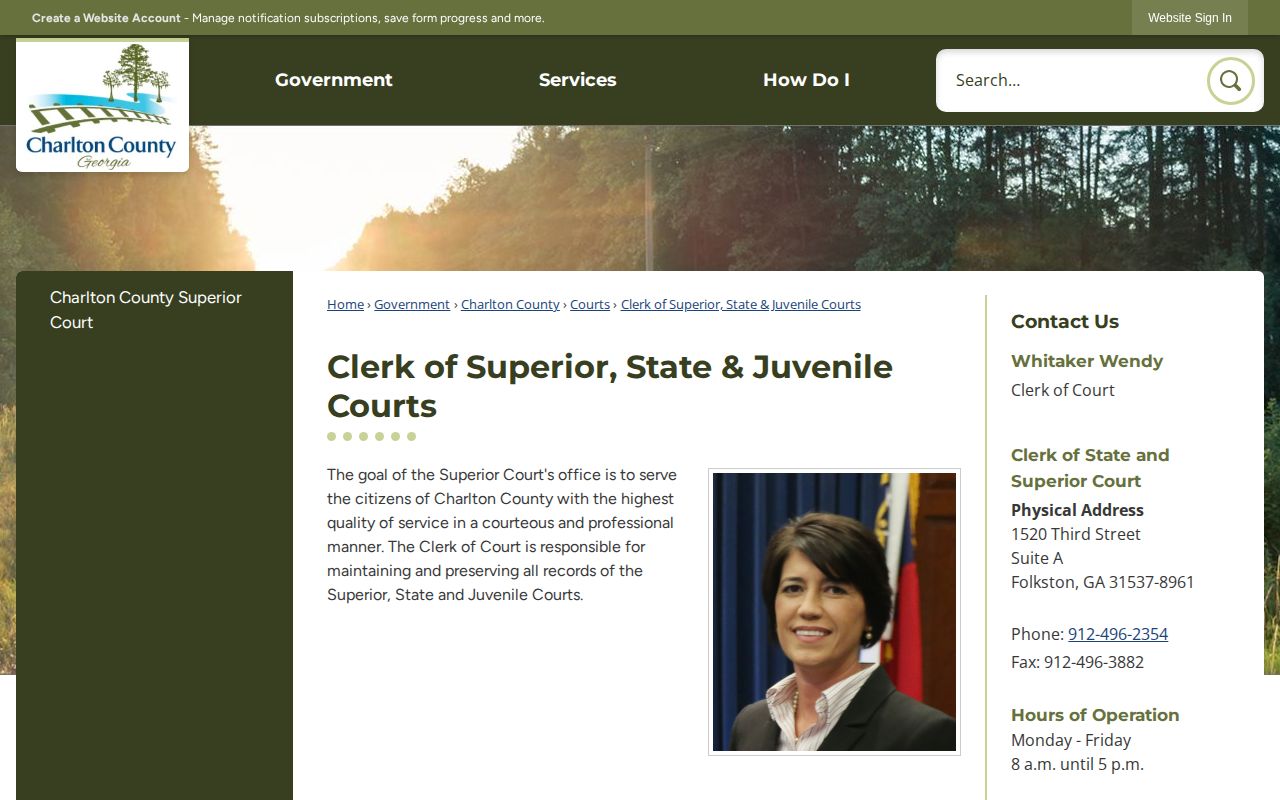
The county clerk page confirms the local office. The image below shows that official source and helps distinguish it from the separate magistrate location.
Charlton Court Release Fields
A useful case review follows the events that could affect custody. Capture the court name, case number, defendant name, filing date, charge count, bond order, disposition, sentence, probation terms, revocation activity, and any completion or discharge notation that has been filed. Restriction or sealing orders matter because they may change what the public can view.
| Court entry | Release question it may answer |
|---|---|
| Bond order | Why release occurred while the case continued |
| Disposition | How the charge was resolved |
| Sentencing order | Whether time served, probation, jail, or prison was imposed |
| Jail-credit notation | How prior custody applied to the sentence |
| Revocation order | Whether supervision changed back to custody |
| Restriction or sealing order | Why a record may no longer appear publicly |
Docket labels can be terse. Request the filed order when the exact terms matter. An entry alone may not state the full conditions or effective date.
Charlton Bond and Release Orders
Bond release ends the jail hold while the criminal case continues. The court record may show who set bond, the amount or type, conditions, and later modifications. The sheriff record should show when the person physically left county custody. These dates may differ because an order can be entered before processing at the jail is complete.
A dismissal, recognizance order, recalled warrant, or sentence of time served can also produce release-related activity. Do not read “released” as “case dismissed.” A person can be out of jail with a pending case, on probation after sentencing, or transferred to another authority. The correct conclusion comes from the order plus the custody record, not from the person's absence from a live roster.
First appearances and some initial bond actions may belong to Magistrate Court. Later felony and state-court proceedings route through the corresponding clerk record. Verify the case caption and court before requesting a copy.
Charlton Sentences and Transfers
A sentencing order can explain whether the person received county confinement, credit for time already served, probation, or a commitment to the Georgia Department of Corrections. A transfer to GDC ends the Charlton County Jail event but continues state custody. The county court file supplies the sentence; GDC supplies the state facility and state release-date data after intake.
Georgia's prison terms use concepts such as Maximum Release Date and Tentative Parole Month. Those are not county court release-list fields. A Maximum Release Date is a GDC calculation exclusive of parole decisions. A TPM is the Parole Board's tentative review month, not a promised release. If the sentence sends the person to state custody, follow the court order into GDC and parole sources.
For county confinement, O.C.G.A. 42-4-7 addresses county earned time and release at sentence expiration less allowed deductions. The court sentence and sheriff calculation should be read together if the expected date is disputed.
Charlton Probation Court Records
Probation is a court sentence served in the community under stated conditions. It is not parole. Parole follows part of a prison sentence and is decided by the Georgia State Board of Pardons and Paroles. A person released from the county jail onto probation may have no TPM or parole record at all. The sentencing order and Department of Community Supervision are the useful sources.
Charlton County is served by the Waycross DCS Field Office for felony probation and parole supervision. A court docket may show the original probation order, later modification, alleged violation, revocation, and discharge or completion activity. An absence from the jail does not establish that supervision ended. Review the current order and use the supervising agency for current routing, subject to disclosure limits.
For an alleged warrant or absconder issue, look for an actual warrant entry, revocation filing, or supervision record. Do not infer a warrant from a missing custody result.
Restricted Charlton Court Records
Georgia often uses the term record restriction where people may expect “expungement.” A restricted or sealed file may not appear through the same public search channels. Juvenile records have added limits. A successful first-offender case can also have a different public record posture after completion. These access changes do not mean every agency copy vanishes at once.
Ask the clerk whether a public docket or order is available rather than assuming that a missing result proves no case existed. The sheriff, court, GDC, and supervision agencies create different records and apply different rules. A restriction order affecting court access does not automatically rewrite a historical jail record, and a jail release does not itself restrict the court case.
Request Charlton Court Records
Describe the exact record sought. Give the case number, party name, court, and approximate filing date. Ask for the docket plus the named order, such as a bond order, sentencing order, revocation order, order of discharge, or restriction order. Certified copies may be needed for a formal court process. Ask the clerk about copy fees and delivery because the research does not provide a complete local fee schedule.
Georgia open-records timing does not erase court-specific access rules. Sealed, restricted, and juvenile material may not be publicly available. Some online documents may also require an account or fee even when the docket can be found. If the portal is unclear, contact the clerk during listed office hours and ask which court owns the file.
After obtaining the order, compare it with the sheriff's release date and type. The Charlton County released inmate search path shows where VINE, sheriff, GDC, parole, and federal checks fit when the court record points to another custody system.
About Charlton Court Records
The Charlton County court records system covered here consists of Superior, State, and Juvenile Court files maintained by the clerk. It is not a detention facility. Its durable value is the ability to preserve judicial events after a jail stay ends. The docket can trace bond, plea, trial, sentence, probation, revocation, and later record-access activity.
Magistrate and Probate Court has a separate Suite B contact and maintains its own matters. That split is a local detail worth checking before each request. A first appearance or preliminary hearing may begin in Magistrate Court, while a felony case moves through Superior Court. State Court handles matters within its jurisdiction, and Juvenile Court records carry special access limits.
For release verification, use the court file as one part of a two-record method. Obtain the sheriff's custody-exit entry for the actual end of jail custody, then obtain the court order that explains the legal event. If the order sends the person to GDC or another authority, continue with that receiving system.