
Georgia TPM Is Future Review
The Georgia State Board of Pardons and Paroles explains that TPM means Tentative Parole Month. It marks when the Board plans final review and, if appropriate, may set a parole release date. The word tentative is essential. A TPM is neither a release order nor a record that the person has left GDC custody.
This system is for prison parole timing. A person arrested in Charlton County and released on bond may never enter it. If the Charlton jail transfers a sentenced person to GDC, the county custody record can close at transfer while the prison and parole process continues. Search the state records only after identifying that state sentence path.
A maximum release date is different. It reflects the GDC sentence endpoint apart from parole. A TPM reflects Board review. The eventual parole release date, actual prison exit, and final discharge from supervision are later and separate events. Keeping each label prevents a family planning around a review month as if it were a fixed gate date.
Search the Georgia TPM Record
The direct Inmate TPM Lookup is the public query route. Use it for a person believed to be serving a Georgia prison sentence and eligible for parole consideration. Start with accurate identity and corrections information. Do not force a likely county-jail match into a state-prison system.
- Confirm through GDC that the person is or was received into Georgia state prison custody.
- Open the Board's TPM lookup and enter the identifying information the form requests.
- Review the returned person and timing details carefully before treating the result as a match.
- Read the TPM as a review month, not an approved release date.
- Check GDC for current facility and maximum release information.
- After actual parole release, move to the Board's Parolee Search and the DCS office serving Charlton County.
The matching screenshot comes from the official Board TPM explanation.
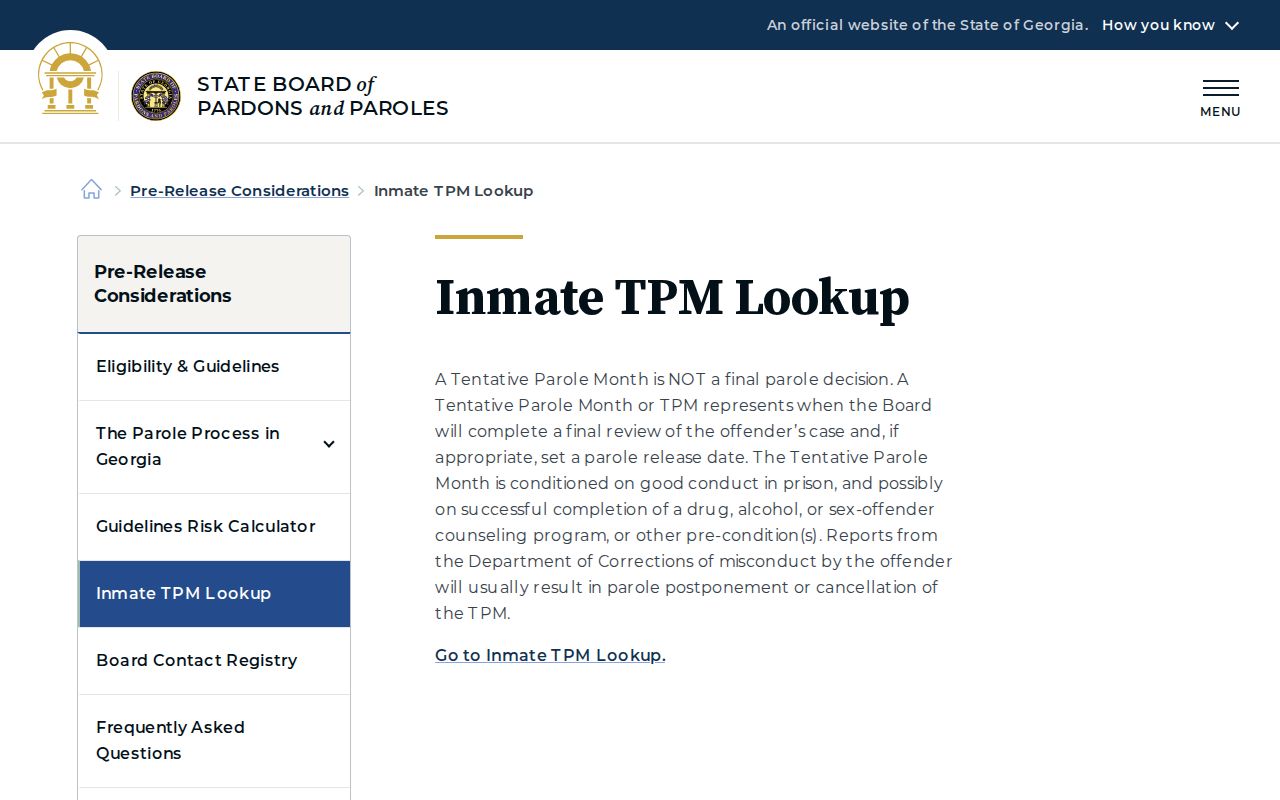
The source makes clear that Board review can lead to a release date but does not turn the tentative month into a promise.
Note: A missing TPM can reflect eligibility, timing, record matching, or case status and should not be read as proof of release.
TPM Lookup Record Meanings
The TPM tool answers a narrow question: what tentative parole-review timing is publicly associated with this state inmate? It does not provide the complete court sentence, all GDC credits, a Charlton County booking sheet, or a permanent history of every Board vote. Pair it with the record that owns each part of the case.
| Record | What it can establish | What it cannot establish alone |
|---|---|---|
| Charlton jail release entry | End and reason for county custody | State parole review |
| GDC offender record | State identity, facility, and release fields | Final Board decision by itself |
| TPM lookup | Tentative Board review month | Guaranteed prison release |
| Parolee Search | Public record of a person already on parole | Probation imposed by a court |
| DCS record | Community supervision routing | Prison custody status |
| Court order | Sentence and later judicial changes | Daily parole vote status |
A result can be useful for planning questions and case follow-up. The person remains in prison until the custody agency completes release. If another authority has a detainer, the release from GDC may lead to transfer rather than a return to the community. The Board timing record does not clear a county, federal, or immigration hold.
Georgia Parole Eligibility and PIC
Eligibility is the legal point at which the Board may consider parole. It is not an order to grant it. The Board says most parole-eligible inmates are statutorily eligible after one-third of a prison sentence, but few receive parole at the first eligibility point. Serious violent felonies and other offense categories can have special mandatory-service or parole limits. The conviction and sentence must be reviewed case by case.
Georgia's parole decision guidelines help the Board evaluate a case, while the final decision remains a Board act. A recommendation expressed as months or a percentage is not the same as a TPM or release date. The person may be denied, reconsidered later, assigned or changed to a TPM, granted release subject to conditions, or have a planned release delayed or rescinded.
GDC's Performance Incentive Credit program can affect eligible timing. GDC says participants may earn up to twelve points, with a potential one-to-twelve-month reduction to TPM or Maximum Release Date. Progress in a case plan, education or vocational work, and job assignments can support points. PIC does not compel a parole grant. Institutional conduct and required programs can still affect final review.
Board Meetings Are Not Hearings
Georgia's public monthly operations meetings should not be mistaken for inmate parole hearings. Official Board notices say those meetings address operational updates, policies, and presentations. They do not include parole reviews, considerations, or decisions for individual people. Board members vote parole cases electronically each day.
The Board press-release index is the current source for meeting notices and cancellations. It is an operations calendar, not a list of people whose parole will be decided in public. The Charlton research found no official daily public granted-or-denied list. Future timing is checked through TPM, while an already released parolee is checked through the parolee database.
Board outcomes can include a grant with release to supervision, denial, later reconsideration, a changed TPM, a delayed planned release, or revocation after an alleged violation. A public operations meeting notice proves none of those outcomes for one inmate. Request the applicable offender or Board record when exact proof is needed.
Note: Georgia parole cases are decided through the Board's case process, not during the public monthly operations meeting.
TPM Lookup Records and Contact
The State Board of Pardons and Paroles owns TPM and parole-decision records. GDC owns prison custody and sentence-calculation records. DCS owns much of the community supervision record after release. Direct a correction or formal request to the agency that owns the disputed entry. A court sentence issue belongs with the sentencing clerk and GDC rather than the public TPM screen alone.
Charlton County's local DCS route is the Waycross Field Office after a person is released to parole. It does not set TPM or vote the prison case. For a local bond, probation, or county sentence release, use the sheriff and court instead. These agency lines should remain clear even when all records concern the same person.
The Charlton County projected release date comparison places TPM beside county earned time and GDC maximum release fields. If no public screen resolves the question, request the current agency record and note the date it was produced.
Why a Georgia TPM Changes
A TPM can move because the Board's review is conditional and the underlying record is still active. Institutional conduct, required counseling or treatment, new case information, a detainer, or a later Board vote may affect the plan. GDC sentence corrections and eligible PIC awards can also change a timing field. None of those changes should be described as a clerical delay without an official record supporting that conclusion.
When two sources display different dates, record the label attached to each. One may be Maximum Release Date, another TPM, and another an actual release date from an earlier custody event. Ask GDC about the prison calculation and the Board about parole review. A Charlton court order can change sentence inputs, but the local sheriff cannot set the state TPM.
Families should also confirm whether a hold would cause transfer at the planned prison exit. A county warrant, federal detainer, or immigration hold can mean that GDC custody ends while another authority begins custody. The Board record does not clear those holds. Final confirmation comes from the releasing and receiving agencies.
A changed TPM is therefore not proof of misconduct or denial. It shows that the tentative review path has changed. Request the current Board record when the reason must be documented, and compare it with GDC and court records before drawing a conclusion.
After the TPM Review
Final review may lead to a parole release date, a denial, or later reconsideration. Even a favorable decision can include preconditions that must be met before departure. GDC remains the custody agency until release processing is complete. The parolee search becomes useful only after the person is released onto parole.
On the expected date, confirm the event with GDC or the Board rather than relying on the old TPM result. If the person transfers under a hold, identify the receiving authority. If release to Charlton County occurs, DCS Waycross is the local supervision route, not the source of the earlier TPM decision.