
Georgia Parolee Release Records
Parole is conditional release after part of a state prison sentence. The State Board of Pardons and Paroles decides the release and maintains the public parolee search. DCS supervises parolees in the community. These roles differ from Charlton County Jail, which records local detention exits, and from the sentencing court, which orders probation.
The parolee database is most useful after a prison release has occurred. A person still in GDC custody belongs in the GDC offender search and may have a TPM record for future review. A person released from the Charlton jail on bond did not become a parolee merely because the person left custody. A transfer from the county jail to GDC is also not parole.
Once a matching public parolee record appears, it can support the fact that the person is under parole rather than in prison. It should be compared with the GDC identity and release record. Community supervision means release from incarceration with legal conditions. It does not mean current custody unless a later arrest or revocation event occurs.
Search a Georgia Released Parolee
The direct Georgia Parolee Search says results return records containing the partial search term. Partial matching can help with name variants, but it can also broaden the result set. Compare all available identifiers and case context before deciding that a record belongs to the person sought.
- Confirm through GDC or a court sentence that the person served a Georgia prison term.
- Open the public parolee search and enter the most accurate name information available.
- Review all returned records that contain the search term.
- Compare identity and state-custody details rather than selecting the first similar name.
- Read the record as parole status, not probation or present prison custody.
- Use DCS Waycross for local supervision routing and the Board for parole-decision records.
The official manifest image comes from the Board's Georgia parole process page.
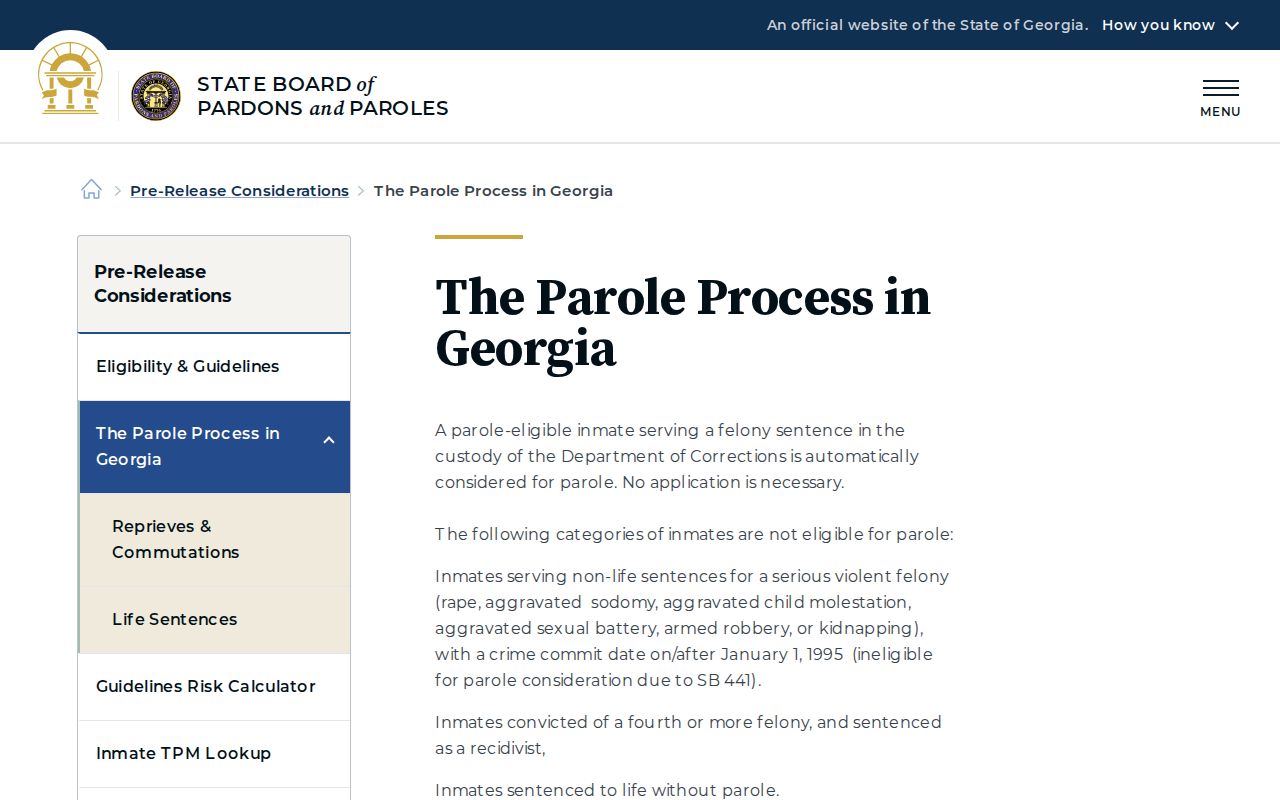
That process context helps distinguish an approved release to parole from tentative review while the person remains in prison.
Read Georgia Parolee Results
A parolee search result should be used as one official layer. The Board's public record may identify the parolee and current parole context, while GDC owns prison custody and release fields. DCS holds field-supervision information, subject to disclosure limits. The court file supplies the sentence and any judicial changes.
| Question | Best source | Why |
|---|---|---|
| Is the person still in state prison? | GDC offender search | Shows state facility and custody fields |
| Is final parole review pending? | TPM lookup | Shows tentative review timing |
| Was the person released on parole? | Parolee Search and Board record | Targets already released parolees |
| Which office serves Charlton? | DCS Waycross | Lists Charlton in its service area |
| Is the person on probation? | Sentencing court and DCS | Probation is imposed by a court |
| Did county jail custody end? | Charlton sheriff release entry | Owns the local jail record |
A result does not show every custody event. Another county, federal, or immigration hold can create a later transfer or arrest. VINE may supply custody alerts where an active data feed exists, but the parolee search remains the public Board route for parole status.
Note: Match a parolee record to the GDC and court history before relying on a partial-name result.
Parole Is Not Charlton Probation
Probation is a court sentence. It may replace incarceration, follow jail time, or form one part of a split sentence. The Parole Board does not turn a Charlton County bond release or probation order into parole. A person can leave the county jail and report under felony probation without ever appearing in the parolee database.
For probation, check the Charlton County Superior or State Court sentence, revocation filings, and any completion or discharge entry. DCS supervises many felony probationers as well as parolees, so the same field office can serve two distinct legal statuses. The underlying order tells which one applies.
A county jail roster, if one existed, would answer current custody rather than community supervision. Charlton's official pages do not publish that roster. Call the sheriff for a local custody exit, use the court for probation, and use the Board search for parole. The Charlton parole and probation comparison places those channels side by side.
Charlton Parole Supervision Office
DCS lists Charlton County under the Waycross Field Office. That office serves Brantley, Charlton, Pierce, and Ware counties and the Waycross Circuit. It is the local route for field supervision after a person returns to Charlton County on parole. It does not vote the parole case or control the GDC prison release calculation.
Privacy and records rules can limit what field staff disclose about a named person. Use the public parolee record first, then ask the office for the proper contact or records route. DCS central contact is 678-783-4337 at 2 MLK Jr Dr SE, Suite 866 E, Atlanta, GA 30334, with weekday hours from 8:00 a.m. to 5:00 p.m.
Address changes, travel approval, reporting, and officer instructions are supervision matters. A parole release date or Board decision belongs to the Board and GDC. Keeping the office roles separate makes a records request more precise.
Violations and Parole Discharge
Parole conditions can require obeying laws, following the community supervision officer's instructions, remaining in Georgia unless travel is approved, and obtaining permission for an address change. A claimed violation may lead to arrest and revocation proceedings. The allegation is not the final outcome. Look for an official warrant, Board action, DCS record, or court entry.
No official Charlton County parole absconder list was found. Absence from the parolee search or county roster does not establish a warrant. A registry compliance record applies only to people with a qualifying registration duty and is not a general parole list. VINE can notify users about a new custody event, but it does not explain the entire supervision case.
Parole ends through a formal discharge or sentence event. Disappearance from a search screen is not enough. Request the Board or supervision record when exact end dates matter. A GDC prison release date proves the custody exit, while the later discharge proves the end of parole obligations. Preserve both dates as separate facts.
Georgia Parole Decisions and Records
The public parolee search is the released-status tool, but it is not a public diary of each vote. Georgia's Board says members decide parole cases electronically each day. Monthly public operations meetings cover policies, reports, and agency business rather than individual parole reviews. A meeting notice should never be used to claim that a named inmate received or lost parole.
Possible case outcomes include a parole grant, denial, later reconsideration, a TPM change, a delayed planned release, or revocation after release. The public parolee database is strongest once parole actually begins. The TPM lookup is strongest for tentative review while the person remains in prison. GDC provides the related custody and release fields. Each record describes a different stage.
If a result appears inconsistent, capture the exact name entry, search date, and available state identifier. Ask the Board for the parole record and GDC for the prison record. A Charlton court file can confirm the sentence or later court order, but it does not substitute for a Board vote. DCS can confirm routing for active community supervision within its disclosure rules.
Full discharge deserves its own proof. A person can be released from GDC and remain on parole, then later complete supervision. Preserve the prison release date and parole discharge date separately. A missing or stale screen should not be used to collapse those two events.
Charlton Release and Parole Sequence
A Charlton case can produce several records in sequence. The sheriff first records local booking and a county custody exit. If that exit is a transfer to GDC, the person remains confined. GDC then maintains the prison placement and sentence fields. The Board may set a TPM, later grant parole, and create the release-to-parole decision. DCS supervises the person in the community.
Each step has its own date and meaning. A county transfer date cannot replace the GDC release date. A TPM cannot replace the Board's actual release action. The prison release date cannot prove that parole has discharged. Compare the records chronologically and keep the identifiers attached to each one.
If the person returns to custody after an alleged violation, VINE or a jail record may show the new event. The Board and DCS records explain the parole consequence. Do not assume that a new booking automatically ended parole or that disappearance from the parolee search proves revocation.