
Charlton Parole and Probation Compared
Parole follows a state prison term. The Georgia State Board of Pardons and Paroles decides whether an eligible prison inmate may leave before the maximum sentence ends. Release does not erase the sentence. The person serves the remaining parole period in the community under stated conditions. Probation comes from a court sentence. A judge may order it instead of confinement, after some jail time, or as part of a split sentence. Someone released from Charlton County Jail on probation may never have a parole record.
Georgia places much of the day-to-day work for both groups with the Department of Community Supervision, or DCS. That shared supervision can blur the legal difference. The source of the status still matters. A parole record points back to a prison sentence and Board decision. A probation record points back to a sentencing order filed in court. The right source also determines how to confirm the start date, terms, possible violation, and final discharge.
| Point | Parole | Probation |
|---|---|---|
| Who orders it | State Board of Pardons and Paroles | Sentencing court |
| When it begins | After release from a Georgia prison | As directed in the court sentence |
| Public confirmation | Parolee Search, Board record, and DCS | Court docket or order and DCS |
| Future date tool | TPM lookup while the person remains in prison | Sentencing and probation orders |
| End of status | Board discharge or sentence completion | Court or agency discharge under the sentence |
- Parole
- Conditional community release after part of a prison sentence.
- Probation
- A court-ordered sentence served in the community under set terms.
- Discharge
- The formal end of a supervision obligation.
- Absconder
- A supervised person alleged to have stopped reporting or left supervision without approval.
Verify Charlton Post-Release Supervision
Begin with the custody history. A person who left Charlton County Jail on bond may have an open case but no parole status. A person sent from the jail to GDC did not return to the community at that transfer point. For a past Georgia prison release, the Georgia Parolee Search is the most direct public parole channel. The Board says its search can return records that contain a partial search term. Match the result carefully to the person rather than relying on a name alone.
Probation verification begins with the court. Charlton County Superior, State, and Juvenile Court records can include a sentencing order, probation terms, revocation filing, or completion entry. Magistrate records may explain an early bond or warrant event, but they are not a substitute for the final sentence in another court. DCS can help route a question about active felony supervision, though privacy and records rules can limit what staff provide by phone.
- Decide whether the person left Charlton County Jail, a GDC prison, federal custody, or ICE custody. Each path has a different record owner.
- For parole, search the Board's parolee database. Compare all available identity and case details before treating a result as a match.
- For probation, check the Charlton sentencing court for the order, term, revocation activity, and any discharge or completion notation.
- Use the DCS field-office finder or the Waycross office page to confirm which office serves the area.
- If the public tools are unclear, request the relevant court, Board, GDC, or DCS record instead of drawing a conclusion from silence.
For a broader custody and release check before choosing a supervision system, use the Charlton County released inmate search path.
Note: A missing parolee-search result does not prove that probation, another supervision type, or a pending court case has ended.
Charlton Supervision Routes Through Waycross
Charlton County's state field office is not in Folkston. The DCS Waycross Field Office expressly lists Charlton among the counties it serves, along with Brantley, Pierce, and Ware and the Waycross Circuit. This is the local routing point for felony probationers and parolees supervised by DCS after release. The office is useful when the question concerns active field supervision, reporting location, or the proper agency contact. It is not the office that sets a prison inmate's parole date.
DCS also lists a central contact at 678-783-4337 and 2 MLK Jr Dr SE, Suite 866 E, Atlanta, GA 30334, with weekday office hours from 8:00 a.m. to 5:00 p.m. The field office remains the more local place to identify, while the central contact can help route agency-wide records or contact questions. Ask for the right office and record type. Staff may not confirm every detail about a specific person to a caller.
The manifest image below comes from the official DCS Waycross office page.
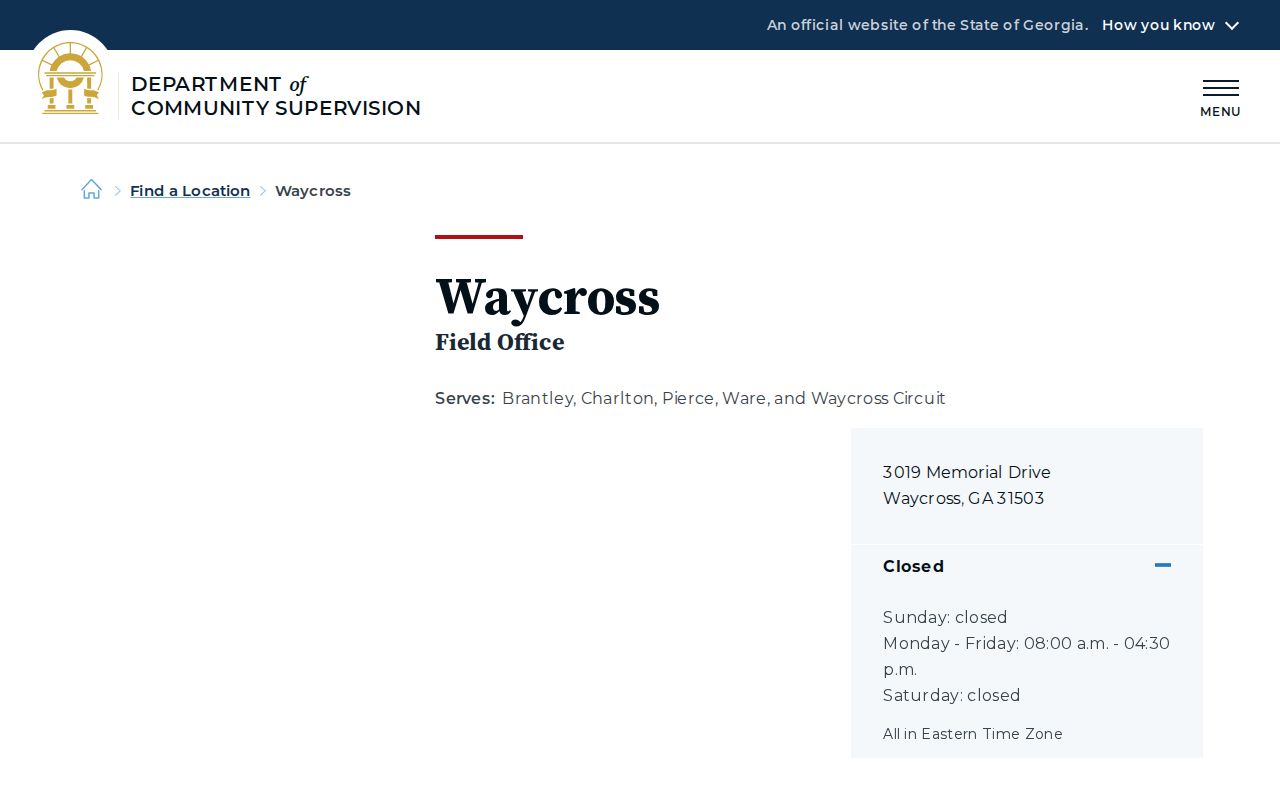
Its Charlton County service listing confirms the local post-release supervision route without turning the office page into a custody or parole-decision record.
Charlton Parole Dates and Decisions
The Board's Tentative Parole Month explanation applies while a person is still in prison and under review. A TPM is not a promised release date. It marks the month when the Board expects to complete final review and may set a parole release date. Good conduct and required programs can matter. New information or unmet conditions can also change the outcome. Once the person has actually left prison on parole, the parolee search and DCS become the more relevant public paths.
Georgia's public meeting calendar can cause confusion. The Board publishes notices for monthly operations meetings through its press-release index. Official Board notices say those meetings cover operations, policy, and presentations, not individual parole reviews or decisions. Board members vote parole cases electronically each day. There is no public daily granted-or-denied list identified in the Charlton research. Eligibility means a case may be considered; it does not mean release has been granted.
Most parole-eligible Georgia inmates may become eligible after one-third of a prison sentence, according to the Board's process material, but special statutes restrict some offenses. Serious violent felony limits require a case-specific review. The Charlton County projected release date page separates TPM, GDC maximum release date, and county jail earned time.
Charlton Supervision Violations and Warrants
Supervision conditions set rules for conduct after release. Parole conditions may require compliance with the community supervision officer's instructions, obeying the law, staying in Georgia unless travel is approved, and obtaining permission for an address change. Probation conditions come from the sentencing court and may include added case-specific terms. A violation allegation can lead to arrest, a revocation process, or a court filing. It does not automatically establish the final result.
No official Charlton County parole, probation, or absconder list was found in the local sources. Do not infer a warrant because someone vanished from a jail roster or does not appear in one public database. Look for an active warrant or revocation entry through the proper court, DCS, or Parole Board channel. For a qualifying registrable offense, the GBI or Charlton registry may carry compliance information, but those registries are not general supervision lists.
VINE can send custody-change alerts while an arrest or custody record is active. It does not report the full course of parole or probation. The Georgia VINE service should therefore be used for release, transfer, escape, or capture notifications, then paired with the supervision record that explains the legal status.
Note: An alleged absconder status should be confirmed through an official warrant, court, Board, or DCS record before it is repeated as fact.
Correct Charlton Supervision Records
Property and identity documents left at release are county jail matters, but Charlton County publishes no detailed online property-release policy. Contact the sheriff for jail property or for an error in a county release entry. A court docket error or missing order belongs with the clerk that holds the case. State prison, parole, and community-supervision records route to GDC, the Parole Board, or DCS. Sending a correction to the record owner avoids asking one agency to alter another agency's file.
A focused correction request should identify the person, record, date, and disputed field. Attach the order or official document that shows the conflict when possible. For example, a court discharge order may support a request to correct a probation entry, while a Board document controls a parole status question. The agency may preserve the old entry while adding a corrected status or later event. A correction is not the same as restricting a court record from public view.
How Charlton Supervision Ends
Supervision ends through a formal event, not merely because a name disappears from a search. Parole may end when the sentence reaches its controlling end point or the Board issues a discharge. Probation may end under the sentencing order, a court action, or a recognized discharge process. A completed term is different from a revocation, transfer, or change of office. The most reliable proof is the final Board, DCS, or court record tied to that status.
For Charlton County probation, request the docket entry or order from the court that imposed the sentence. For parole, use the parolee search as a first check and request an official record when exact dates or a final discharge must be documented. A GDC release date proves departure from state prison custody, but it may not prove that parole supervision has ended. Keep custody, release, and supervision dates in separate fields when comparing records.